
Engineering
Engineered by the people who maintain it.
We design, build and maintain cooling towers end to end with our own engineers and technicians — aligned with tower OEM specifications and supported by world-leading cooling technology providers.
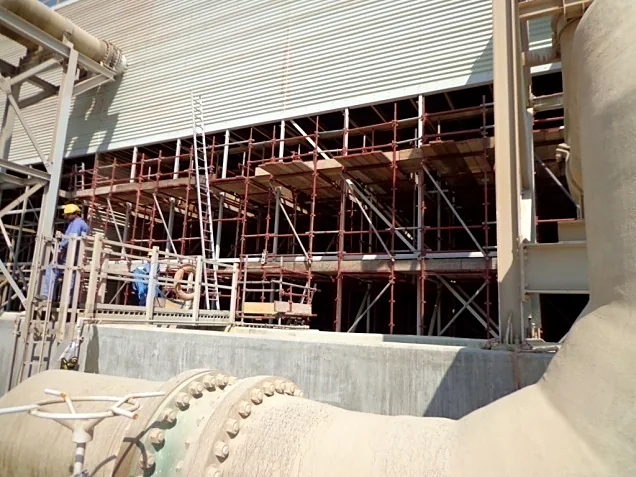
How we work
In-house, end to end
In-house engineering and site teams, with clear responsibility from planning through maintenance.
OEM-aligned
Work carried out to the tower manufacturer’s specifications, with support from world-leading cooling technology providers.
Zero injuries since 2011
No injuries reported since 2011 across our own staff and subcontractors — work planned to operator permit-to-work requirements under an ISO 45001-certified system.
Inside a cooling tower
Every component, one accountable team.
A counterflow tower draws air up through falling water. Each component affects the others — which is why we engineer changes to the whole system, not part by part.
Thermal performance
Measured, not guessed.
A tower’s performance is judged by two numbers: the range it cools the water through, and how close it brings the water to the air’s wet-bulb temperature — the approach. Fouled fill, poor distribution or weak airflow widen the approach and send warmer water back to the process.
- Performance testing to CTI ATC-105
- Thermal design and upgrade calculations in-house
- Fill and fan selection for the required duty
- Post-completion performance testing, where specified
Fill selection
The right fill for your water.
Fill is where heat leaves the water. Choosing it for the plant’s water quality is how we raise capacity inside an existing structure — up to 42% on one concrete tower.
| Fill type | Thermal performance | Fouling resistance | Best for |
|---|---|---|---|
| Film fill | Highest | Lower | Clean or treated water; maximum duty in a compact tower |
| Low-fouling film fill | High | Medium | Moderate water quality where film-fill efficiency is still wanted |
| Grid / splash fill | Moderate | Highest | Dirty or high-solids water; robust, easy to clean |
| Film + grid combination | High | High | Balancing performance and fouling risk in one fill pack |
Troubleshooting
Symptom, cause, fix.
The problems plant teams bring to us most often — and how we resolve them.
| What you see | Likely cause | What we do |
|---|---|---|
| Cold-water temperature too high | Fouled or collapsed fill · poor water distribution · low airflow | Performance test, fill cleaning or replacement, nozzle repair, fan blade angle setting |
| Vibration or noise from the fan | Shaft misalignment · gearbox wear · blade imbalance or damage | Laser alignment, vibration analysis, gearbox overhaul, blade repair and pitch setting |
| Drift and water loss | Damaged or displaced drift eliminators · overflowing distribution | Drift eliminator replacement (0.0005% of circulating flow), distribution repair |
| Dry spots and uneven distribution | Clogged or displaced nozzles · broken laterals | Nozzle replacement, FRP / PVC lateral repair or upgrade |
| Scale, algae and fouling | Water chemistry · suspended solids | Water analysis, hydro-jet cleaning, side-stream filtration |
| Structural deterioration | Timber decay · steel corrosion · FRP damage | FRP repairs, epoxy coating, timber-to-FRP reconstruction |
Mechanical reliability
True, balanced and quiet.
Most unplanned tower outages start in the mechanical train. We measure before we adjust.
- Laser shaft alignment of motor, drive shaft and gearbox
- Vibration analysis to find imbalance, misalignment and bearing wear
- Gearbox, fan and drive-shaft overhaul or replacement
- Fan blade angle setting and tip clearance
- New fan designs for more airflow at lower power
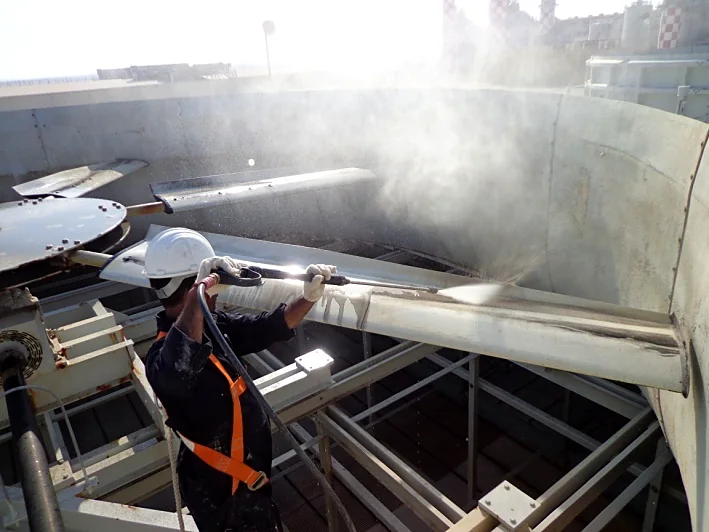
Ask for a performance assessment
We will test your tower and show what an upgrade could deliver.
Contact us